
Introduction: The Relatable Sourcing Trap
From a 30,000-foot boardroom view, the mandate is clear: maximize shareholder value and drive growth. Yet, as companies descend into the “landing patterns” of daily operations, a dangerous gap emerges. Why do organizations that boast the lowest purchase prices often suffer from the most bloated operating costs?
The answer is simple: traditional “buying” is an administrative relic. In the firm of the future, procurement is no longer a back-office function, it is a boardroom-level weapon. Stop chasing superficial discounts and start managing systems. To win in a globalized market, leaders must look beyond the sticker price to capture the “Hidden Billions” through strategic cost management. By adopting the categorization models used by giants like IBM and Honda, you can transform your supply chain from a cost center into a sustainable competitive advantage.
1. The Iceberg Effect: Why Price is Only a Fraction of Cost
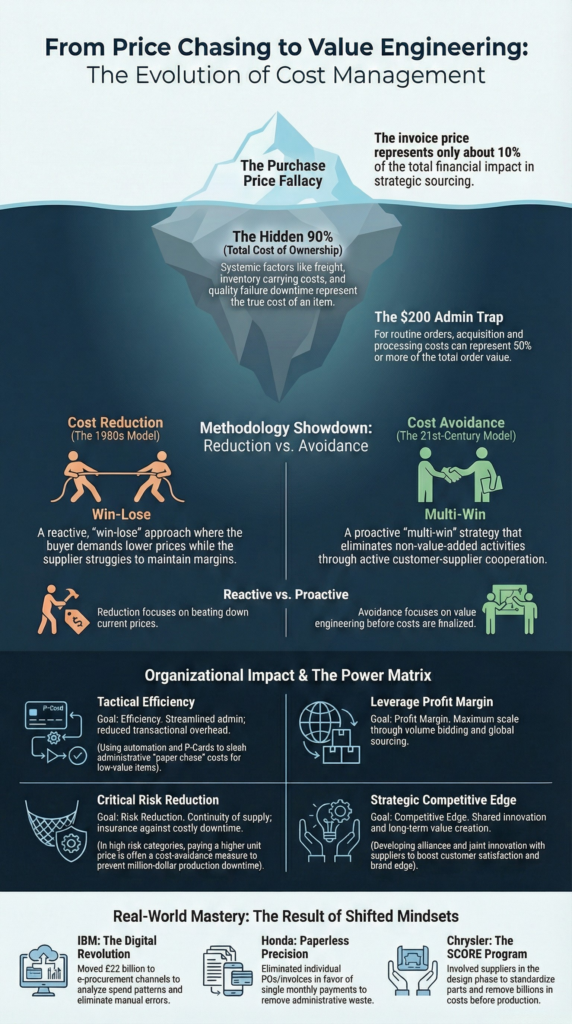
In strategic sourcing, the purchase price is merely the visible tip of the iceberg. Beneath the waterline lies the Total Cost of Ownership (TCO), representing 90% of the financial impact. While 1980s-style “Cost Reduction” obsesses over the invoice, modern “Cost Management” addresses the systemic factors that drive the final bill.
The goal of modern procurement is to get cost out of the system, rather than simply beating down suppliers.
Gene Richter, former CPO, IBM
For tactical, low-value items, the administrative “paper chase” is a silent profit killer. Source data confirms a staggering reality: for many routine orders, the acquisition cost can represent 50% or more of the total order cost. When a single purchase order costs $200 to process, a “cheap” part becomes a liability.
Systemic TCO factors include:
• Freight and Landed Costs: The true expense of moving and storing goods globally.
• Inventory Carrying Costs: Capital locked in warehouses and the risk of obsolescence.
• Transactional/Administrative Overheads: The hidden cost of manual POs and invoices.
• Quality Failure and Downtime: The catastrophic “Cost of Failure” when a plant goes dark due to a sub-standard component.
2. The Power Matrix: Categorizing Spend Like a Pro
Leading organizations do not treat every dollar spent the same way. They utilize a Supply Segmentation Matrix to prioritize resources where they yield the highest returns.
| Quadrant | Goal | Typical Strategy |
|---|---|---|
| Tactical | Efficiency | Streamline/Automate (P-Cards to slash admin costs) |
| Leverage | Profit Margin | Volume Bidding and Global Sourcing for scale |
| Critical | Risk Reduction | Continuity of Supply and Technical Expertise |
| Strategic | Competitive Advantage | Alliances and Joint Innovation |
• Tactical: Low-risk, low-value items (office supplies) where the mission is to minimize the time spent on the transaction itself.
• Leverage: High-value, low-risk items (basic production materials). This is the arena for volume leveraging and aggressive global sourcing to maximize profit margins. | Critical: Low-value, high-risk items (specialty chemicals). Here, reliability outweighs price. The goal is risk mitigation to avoid the massive costs of disruption.
• Strategic: High-value, high-risk items. Success here is measured in customer satisfaction and value-added, not purchase price. These are the components that define your brand’s distinctive edge.
3. The Subtle Shift: Cost Reduction vs. Cost Avoidance
Winning in the 21st century requires an aggressive shift in mindset from reactive price-beating to proactive value engineering.
• Cost Reduction (The 1980s Model): A reactive, “win-lose” approach. The customer remains passive, simply demanding a lower price while the supplier struggles to maintain margins.
• Cost Avoidance (The 21st-Century Model): A proactive, “multi-win” strategy. It requires Active Participation where the customer and supplier cooperate to eliminate non-value-added activities before costs are ever “locked in.”
Strategic Cost Management requires a willingness to cooperate and open doors to trading partners. We must look at the total cost equation, identify where costs exist in the system, and determine what it takes to remove them.
4. Real-World Mastery: How the Giants Do It
Global leaders have already moved beyond transactional buying. Their success provides a blueprint for the “Firm of the Future”:
1. IBM’s E-Procurement Revolution: IBM set an aggressive target to move $22 billion in annualized purchases through electronic channels. By capturing data in real-time, they replaced the “box of candy for the typing pool” with a digital system that analyzes spend patterns instantly.
2. Honda’s Paperless Precision: For metal body component stamping, Honda eliminated individual POs and invoices. They rely on a single, precisely timed payment each month to an integrated partner, ruthlessly attacking administrative waste.
3. Chrysler’s SCORE Program: Through “Platform Teams,” Chrysler involves suppliers in the design phase. Their SCORE program removed billions of dollars from their cost base by standardizing parts before the prototype was even built.
The Boardroom Rule: Supplier selection is no longer about who is the best today. It is about identifying who will be a world leader in two to four years.
5. The “Critical” Paradox: When Paying More Actually Saves Money
In the Critical quadrant (low value/high risk), a “lowest price” strategy is a trap. For specialty chemicals or custom spare parts, “Value” is measured by reliability.
This is where the Cost of Failure dominates the TCO iceberg. Paying a premium to a technically expert, reliable supplier is a proactive cost-avoidance measure. If a $10 part prevents a million-dollar production line from going dark, the unit price is irrelevant. In this quadrant, you are not buying a product; you are buying insurance against downtime.
6. Conclusion: The Future is Synchronized
We are entering the era of Supply Chain Synchronization and Virtual Value Networks. The old model of “push-based” supply chains, where you buy what is available, is dead. It is being replaced by “pull-based” networks where entire supplier-customer teams compete against other teams to deliver value.
Modern procurement is not about who can shout the loudest for a discount. It is about who can build the most efficient, integrated network. The organizations that thrive will treat their supply chain as an extended enterprise, sharing information and risk for mutual gain.
Is your organization still chasing the lowest price, or are you finally ready to capture the highest value?
One response to “The Hidden Billions: Why Cost Avoidance is the New Corporate Competitive Weapon”
[…] The Hidden Billions: Why Cost Avoidance is the New Corporate Competitive Weapon […]